Home > Die Springs
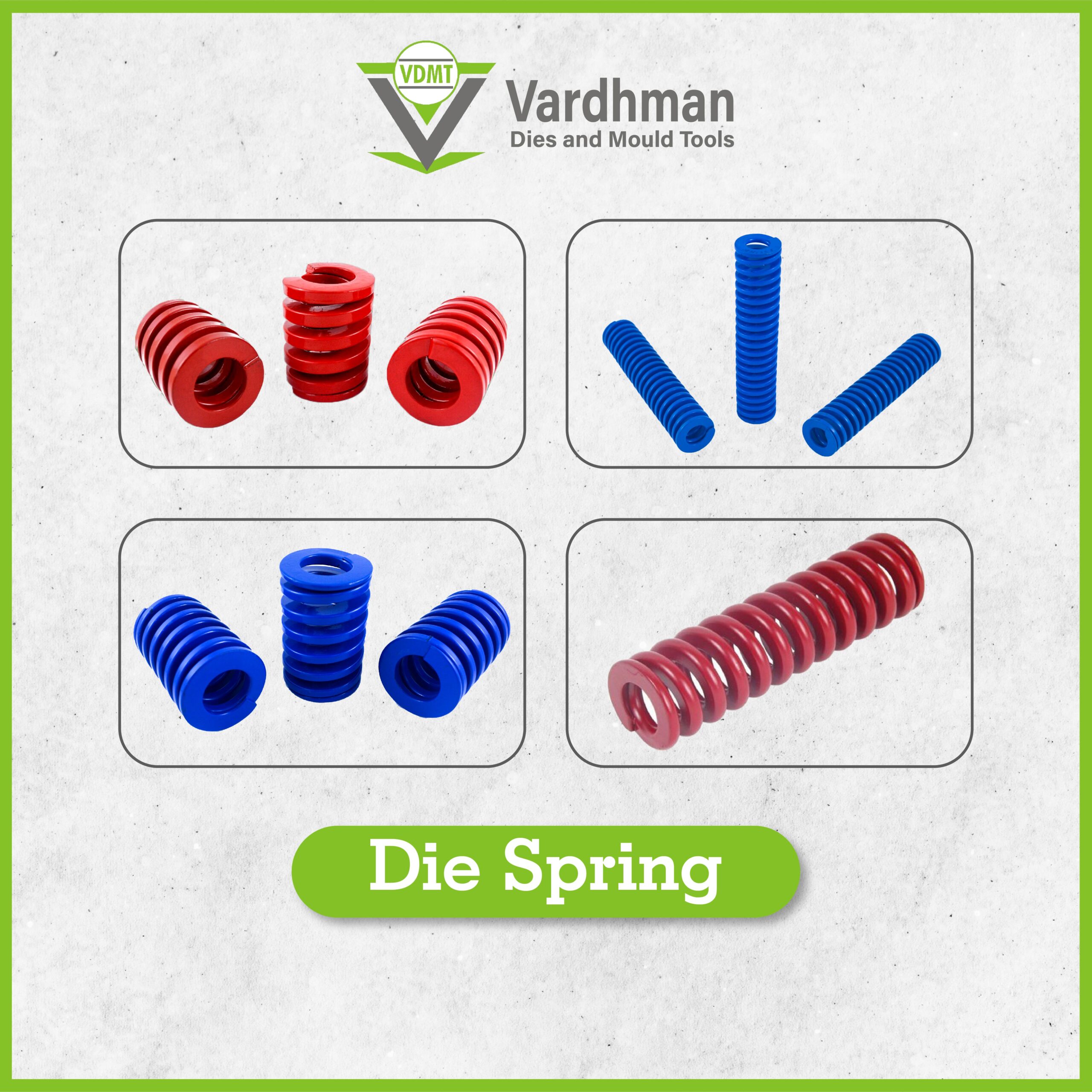
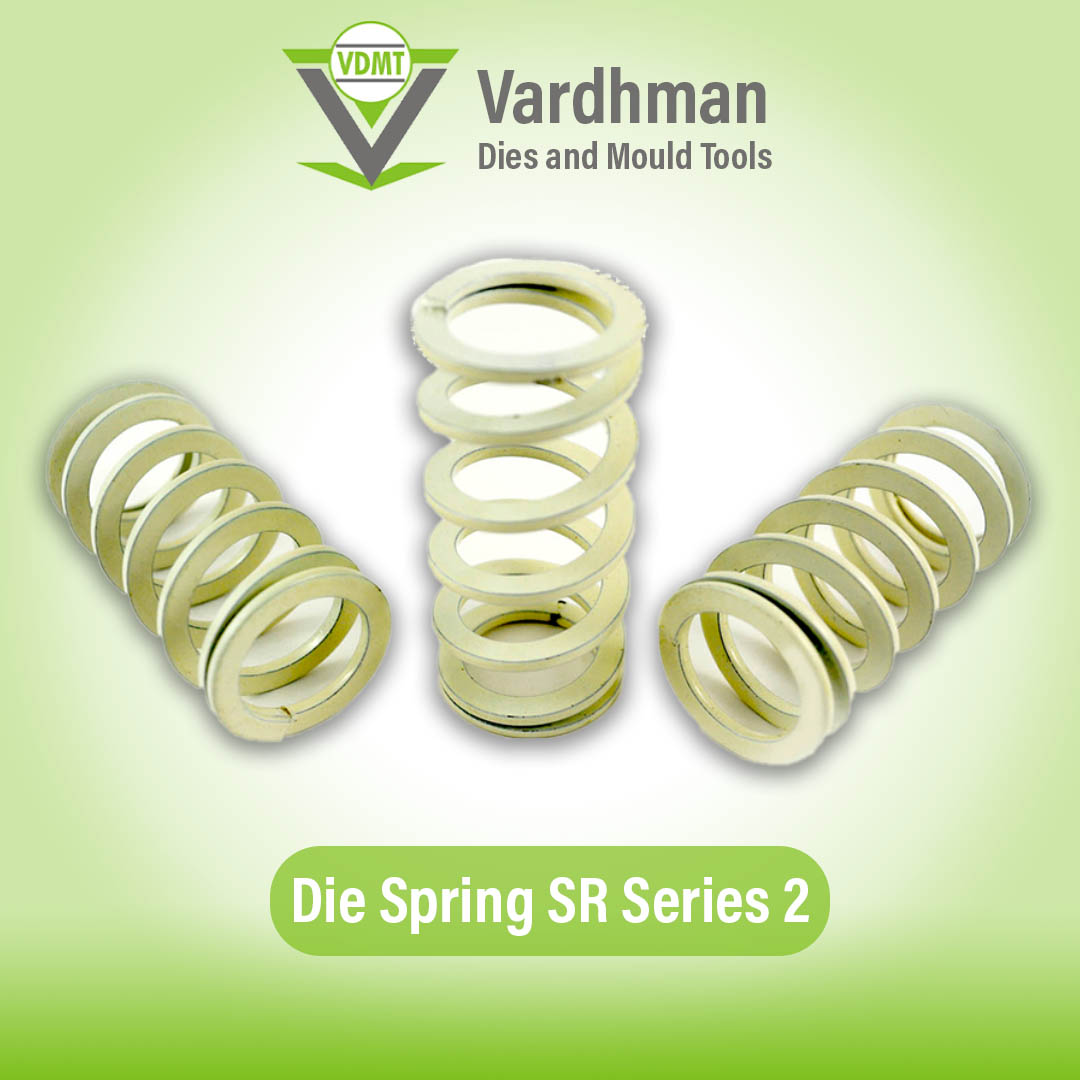
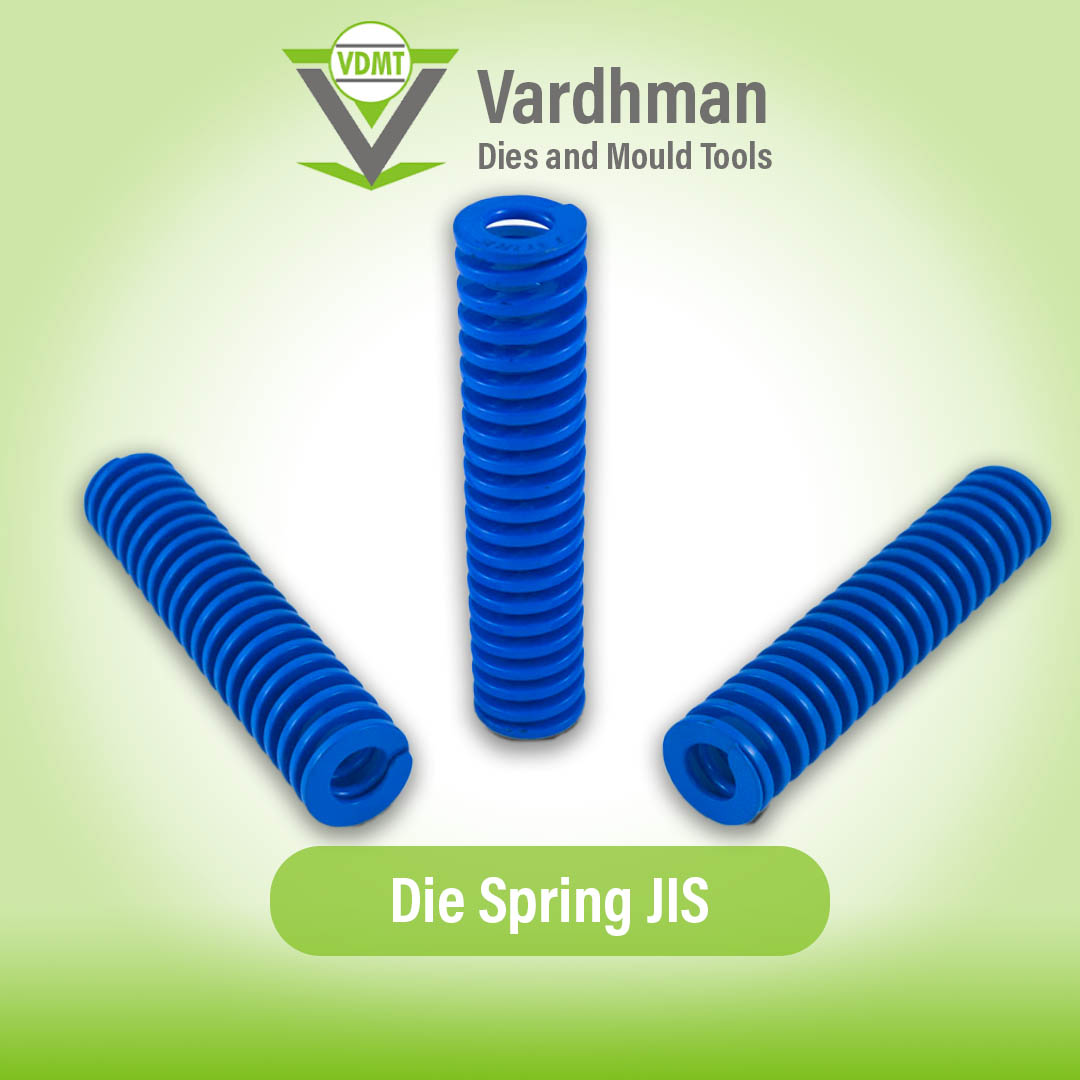
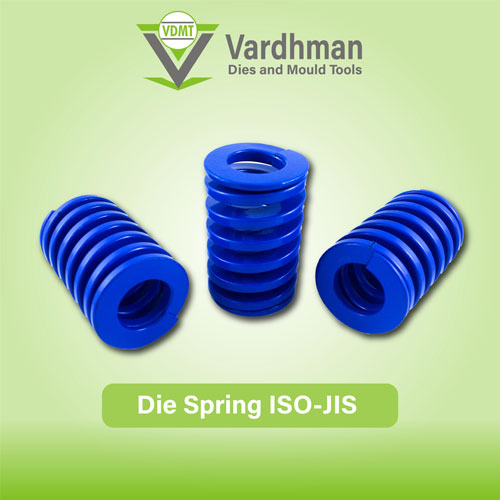
Buy best price, durable and superior performance Die Springs, Die Springs (Die spring ISO Red, Die spring ISO Yellow, Die spring ISO JIS Blue, Die spring ISO –JIS, Die spring JIS Red, Die spring JIS, Die spring SR series 2, Die spring SR series) from Vardhman Dies & Mould Tools – one of the largest manufacturers, exporters and suppliers of Die Springs in Mumbai, India. Vardhman Dies & Mould Tools is India’s leading Industrial Die Springs exporter in Mumbai known for producing quality-tested products.
At Vardhman Dies & Mould Tools, we supply Die Springs, Press tools Accessories, Die Springs, Mould Ejection System, Mould Alignment Products, Mould Latches, Mould Parting lock, Mould Date Indicators, Mould Cooling Products, Sprue Bush, Mould Base, Mould Counter, Mould Spray, Piercing Punches, Polyurethane Elastomers, Ball cage, and Dies and Mould Polishing and Finishing Tools that fit your production requirement and minimise overall cost.
Vardhman Dies & Mould Tools manufacturing and exporting high quality Die Springs worldwide.
Vardhman Dies & Mould Tools offers a comprehensive line of Die Springs functionally designed and manufactures a complete line of industrial die springs in both oil-tempered and chrome-alloy materials. Die springs are used primarily in die machinery, and also in well-suited for many industrial applications where high-static or shock-load stresses are required, or when maximum cycle-life is important.
The Features Vardhman Dies & Mould Tools’ Die springs:
Vardhman Dies & Mould Tools’ Die Springs have numerous applications in the Engineering industry all around the world and are used in the moulding and die-casting industry to meet different industrial applications.
Vardhman Dies & Mould Tools is one of the leading manufacturers, suppliers, and exporters of Die Springs in India. These products are manufactured from high-quality materials that are long lasting and hard wearing, and produce excellent results. Materials are sourced from trusted and reliable vendors and are manufactured at our manufacturing unit using latest machineries in compliance with industry quality standards to meet the requirements of the Dies & Mould Tools Industries.
Order the products your company requires, Contact Vardhman Dies & Mould Tools at + (91) 932 406 1804 or submit Enquiry Form. For more information on any of our high quality products and Get Quotes within hours.
Agra, Ahmedabad, Amritsar, Bangalore, Bhopal, Bhubaneshwar, Chennai, Coimbatore, Delhi, Faridabad, Gandhinagar, Ghaziabad, Goa, Guwahati, Hyderabad, Indore, Jaipur, Lucknow, Mangalore, Meerut, Mohali, Moradabad, Mysore, Nagpur, Nasik, Panchkula, Panipat, Patna, Pune, Rajkot, Ranchi, Rishikesh, Secunderabad, Sonipat, Surat, Thane, Vadodra, Valsad, Vapi, Varanasi
South Africa, Nigeria, Kenya, Ghana, Egypt, Oman, Qatar, Kuwait, Saudi Arabia, Dubai, United Arab Emirates, Iran, Australia, New Zealand, Bangladesh, Bhutan, Indonesia, Malaysia, Nepal, Singapore, Sri Lanka, Thailand, Argentina, Uruguay, Chile, Peru, Austria, Denmark, France, Germany, Italy, Netherlands, Portugal, Spain, Ukraine, United Kingdom (UK), Czech Republic
A die spring is a high-force compression spring designed for moulds, press tools, fixtures and industrial mechanisms where substantial force is required in limited space. It is selected by standard or series, hole diameter, rod diameter, free length, spring rate, preload, working stroke, total compression, cycle frequency and operating environment.
Die springs commonly use shaped or rectangular wire and are engineered to provide greater force in a compact envelope. Standard compression springs may use round wire and different design limits. The correct comparison requires equal dimensions, deflection and material; Vardhman’s unqualified 30% higher-load claim should not be treated as universal.
A shaped wire section can place more spring material in the available radial space and help deliver higher force within a compact hole-and-rod envelope. The exact section, stress distribution and load capacity depend on the standard and manufacturer. Vardhman should identify which series are rectangular wire and which are round wire.
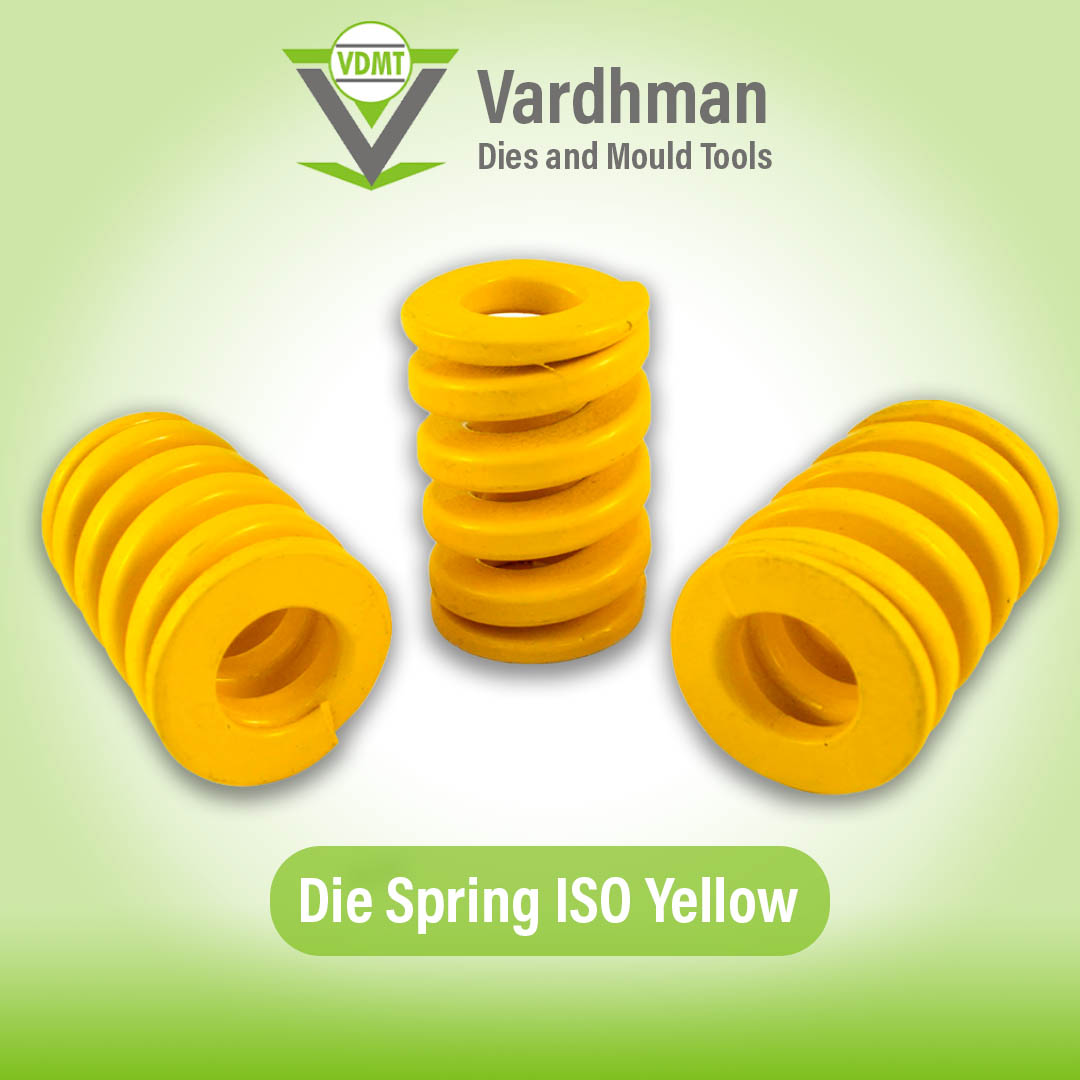
An ISO 10243 die spring is a rectangular-section compression spring designed to the dimensional and identification requirements of the ISO 10243 standard. Buyers should select by declared duty series, hole diameter, rod diameter, free length, spring rate, recommended deflection and force values from the exact manufacturer’s table.
Colour normally identifies a duty or load range within a specific manufacturer and standard. It is not a universal force value. The same colour can represent a different class in ISO, JIS or American systems. Always verify the declared standard, part number, spring rate and force table before substitution.
The live site uses ‘ISO JIS‘ and ‘ISO JIS Blue’ product names but does not explain whether these are cross-reference products, combined dimensional families or incorrect naming. Because ISO and JIS are separate systems, Vardhman should state the exact standard, series code and load data before publication.
Hole diameter is the recommended containment-pocket diameter around the spring. It must allow manufacturing tolerance and the spring’s outside diameter growth during compression without excessive wall friction. Use the exact catalogue value for the selected series rather than measuring colour-equivalent springs from another standard.
Spring rate is the force increase per unit of compression within the usable linear range. Using F = k × compression, a higher-rate spring produces more force for the same travel. The rate must come from the exact series and part number; it cannot be determined safely from colour or free length alone.
Working stroke is the additional compression during the operating cycle after the spring has been preloaded. It should be determined from actual tool movement, including tolerances and over-travel. Working stroke cannot be evaluated alone because total compression equals preload plus stroke.
Solid height is the compacted condition where coils approach or reach coil-to-coil contact. It is not the normal operating target. The selected spring’s maximum operating deflection must remain below its solid condition with adequate tolerance for tool variation, heat and manufacturing differences.
Disclaimer: Product information, specifications, grades, images and applications are for general reference only and may vary by product and requirement. Please confirm final specifications and suitability with our team before ordering. © 2026 Vardhman Dies & Mould Tools. All Rights Reserved. Unauthorised copying or reuse of website content is prohibited. Terms of Use | Privacy Policy | [email protected]
Fill out the form and we’ll be in touch as soon as possible.